Shock Top: Beer for the Discerning Palette


Moxie's in Mississauga's Square One location is featuring a new beer, or at least a beer I hadn't seen on their menu before.

It is Shock Top Wheat IPA (Indian Pale Ale).
The Shock Top line is one of the Anheuser-Busch “craft” beer arms, and the brand revolves around a Belgian Wit (or “White”) style of beer (in the same vein as Coors and their Blue Moon series); in addition to the main Shock Top Belgian White, they also produce a Raspberry Wheat and a Pumpkin Wheat—and now, a Wheat IPA [Source: The Brew Site].
And more on Anheuser-Busch:
Based in St. Louis, Anheuser-Busch is the leading American brewer, holding a 47.6 percent share of U.S. beer sales to retailers. The company brews the world’s largest-selling beers, Budweiser and Bud Light, and distributes these and many other popular brands through a strong network of more than 600 independent wholesalers [Source: Anheuser-Busch].
Here are the notes I took as I was tasting the beer (the waitress had brought me a sample since it is a new feature in the restaurant). I'm not a beer sommelier, so my assessment is purely based on my own amateur palette:

Substance - Malty
Balance - Sweet/Dry
Taste - Tangy/Citrusy
Color - Yellowish, Straw-like
Clarity - Opaque
Sedements- Some
Froth - Slightly effervescent
After taste - None

It is difficult to find a full review of the beer, perhaps because it is so new. Nonetheless, Here is a short essay on the beer from this site, which I've edited for better reading, and highlighted the important information:
As many of you may already be aware, back in October of last year [2011] Shock Top announced that they would soon be producing a “hybrid” profile beer called the Wheat I.P.A. Unfortunately for the beer consuming masses, very little information about Shock Top’s new project has surfaced since that announcement. That is, until now. Earlier today I managed to get a hold of a bottle of the new Wheat I.P.A. and let me tell you, this is one interesting beer. Set to release country wide on February 6, 2012, the WIPA combines the bright citrus notes of a wheat beer and the traditional hoppiness of an India Pale Ale. Once again, Shock Top has continued to broaden the scope of profiles in which beer manifests itself.

Once poured from the bottle, the brew's most notable trait is its cloudiness. Similar to an unfiltered hefe-weizen, the golden hued Wheat I.P.A. is nearly opaque and contains sediments left over from the brewing process. The nose of the beer is instantly recognizable as a wheat beer boasting a variety of several crisp citrus aromas. As I took my first taste, the WIPA’s citrus profile immediately grabbed my attention. However, within a few brief seconds an out-of-the-ordinary bitterness typically associated with strong and bold I.P.A.’s takes center stage. Just as quickly as the flavor appeared, the WIPA’s bitterness begins to subdue and the brew begins to transmute, yet again, into a classic wheat beer. I have to admit that I had a fairly difficult time finding and isolating the coriander notes touted on the bottle’s label, but regardless the beer is well balanced and chocked full of flavor. [Shock Top has a] clean and refreshing finish sans the bitterness.

There you have it, a new unique and delicious hybrid beer that delivers bright flavors and bold profiles to satiate almost any drinker’s palette.

I don't think I did too bad!

I may not be a beer sommelier, I do cook, and I do experiment with cooking. And I've had some pretty good results.

If this beer is available in your region, you can drink it alone, since it is sturdy enough to have without a meal.

But I would recommend it with a meal of pork chops.

I have a pork chop recipe ready, which I embellished from this New York City restaurant's chef oeuvre.

My pork chop recipe, Pork Chops à la Kidist is here.

Pork Chops à la Kidist, and Thoughts on NYC Architecture


The Unassuming Bistro Daniel Boulud, on 55 West 44th Street (between Fifth and Sixth)

Julia Child brought in French Chef Daniel Boulud for her Master Chefs series yesterday (actually its archival material, since Child died in 2004). Boulud has various restaurants, cafes, bistros, bars and epiceries in New York City. He has a restaurant in the trendy Yorkville of Toronto.

Child asked him to make his veal chops, and what a process! Here is the video.

I personally find veal to be a little bland, and it has an after taste I can recognize immediately (and do not like), whether barbecued, minced in spaghetti sauce, or grilled as chops.

I prefer the robust tastes of pork and beef, and can make my own version of pork chops with ingredients very similar to what Boulud used.

Here are my ingredients and cooking instructions:

Pork Chops à la Kidist

(Serves 3)

3 medium sized pork chop
5 or six shallots
2 tablespoons oil
2 tablespoons Worcester sauce
1 tablesoon flour
Juice from three oranges
4-5 teaspoons plain Dijon mustard
1/4 cup water
Salt and Pepper to taste

Coat the pork chops on both sides with the Dijon mustard

Cook the chops on the stove, with the lid on and low heat until done

Put the heat up, and sear the chops on both sides for about a minute each

Remove the chops from the skillet

Cook the shallots, minced, in the pork fat in the same pan as the chops. Add oil if necessary. Scrape the pan to get all the flavors

Divide the mixture in half

Leave one portion in the pan, add the orange juice and Worcester sauce, and reduce it to a syrupy consistency

Put the other mixture in another pan, stir in about 1/4 cup water, and warm it up

Add the browned flour to thicken up the mixture to make a gravy

Add salt and pepper to taste

Smear the syrupy mixture over the chops

Pour some of the gravy over the chops

Serve the rest of the gravy in a separate gravy boat

As the photo shows, you can also add some parsley to the mixture for additional taste

Serve the chops with sauted green beans

---------------------------------------------------------------------------------------------------------------------------------------------------

I looked up Daniel Boulud's restaurants and found that I have actually passed one by while in New York. In fact it is right beside a small and pleasant diner called The Red Flame, on 67 West 44th Street, where I've had at least three meals, and in good company. Daniel Boulud's Bistro Moderne is just up the road on 55 West 44th Street, and in a lovely building. I wonder why I hadn't gone in and order a soup, or something "inexpensive." And from the menu, I think I could have managed that. Their cheapest item is the Soupe du Jour for $12.

Boulud's bistro is in the former City Club building, which, "In 1904...was a non-partisal political club for Democrats and Republicans to meet up and chat among layers of cigar smoke." The Harvard Club and the Algonquin Hotel, which I have also walked by and where the legendary Algonquin Round Table that met, are also on the street.

I couldn't find the architect for the City Club building. The best that I can find online is this site, which points to Lord and Hewlett as the architects of the City Club building, and this site which lists them as the designers of the building's dedication in 1904. And here [pdf file] is a site on James Monroe Hewlett as "architect, muralist, designer," written by his granddaughter Anglesea Parkhurst Newman in 2009.

The designers of the building for the Algonquin Hotel are Starrett & van Vleck, who designed many of New York's department stores, including: Lord & Taylor, Bloomingdales, Saks Fifth Avenue, Abraham & Straus, and Alexander's.

The Harvard Club's original wing
...built in 1894, was designed in red brick neo-Georgian style by Charles Follen McKim of McKim, Mead & White. [Source: Wikipedia]
McKim also built the Morgan Library, in mid-town Manhattan. Here's a (pictorial) list of buildings by McKim, with his partners Mead and White, which includes the beautiful Plaza Hotel by Central Park and the Metropolitan Museum of Art.


The Algounin Round Table plaque on the Algonquin Hotel


The Harvard Club

Book Project:
An Introduction to Beauty: Seek and Ye Shall Find


The Sistine Chapel

Pope Benedict XVI said when addressing a group of artists assembled at the Sistine Chapel:
Beauty, whether that of the natural universe or that expressed in art, precisely because it opens up and broadens the horizons of human awareness, pointing us beyond ourselves, bringing us face to face with the abyss of Infinity, can become a path towards the transcendent, towards the ultimate Mystery, towards God. [1]
Or to put it in reference to beauty:
God points us towards Beauty.
In our age of spiritual drought, these words from Matthew Chapter 7, verse 8 give encouragement:

Seek, and ye shall find.

What I am seeking in these chapters of Reclaiming Beauty is beauty itself. But my task is bigger than mere seeking. My task is to recover the beauty that our modern world has so meticulously and furtively discarded. This elimination of beauty has to be furtive because an attack on beauty is an attack on the way people live, or aspire to live, and any direct attack would ignite the wrath of citizens who are accustomed to having beauty around them. It is meticulous because a haphazard sweep would not be able to remove the overwhelming presence of beauty, and every corner has to be swept clean of this beauty that has become the fabric of society.

Aleksandr Solzhenitsyn, who survived years in a Soviet gulag, wrote [2]:
Dostoevsky once enigmatically let drop the phrase: "Beauty will save the world." What does this mean? For a long time I thought it merely a phrase. Was such a thing possible? When in our bloodthirsty history did beauty ever save anyone from anything? Ennobled, elevated, yes; but whom has it saved?

There is, however, something special in the essence of beauty, a special quality in art: the conviction carried by a genuine work of art is absolute and subdues even a resistant heart. A political speech, hasty newspaper comment, a social program, a philosophical system can, as far as appearances are concerned, be built smoothly and consistently on an error or a lie; and what is concealed and distorted will not be immediately clear. But then to counteract it comes a contradictory speech, commentary, program, or differently constructed philosophy - and again everything seems smooth and graceful, and again hangs together. That is why they inspire trust - and distrust.

There is no point asserting and reasserting what the heart cannot believe.

A work of art contains its verification in itself: artificial, strained concepts do not withstand the test of being turned into images; they fall to pieces, turn out to be sickly and pale, convince no one. Works which draw on truth and present it to us in live and concentrated form grip us, compellingly involve us, and no one ever, not even ages hence, will come forth to refute them.
People are often hard-pressed to define what constitutes beauty, or the beautiful for them. But they recognize it once they see it, and they desperately miss it when its not there.

Modern elites, working as the anti-beauty brigade, diligently work at putting ugliness on the same sliding scale as beauty [3]. They understand that there are different levels of beauty. Something pretty for example is a lower manifestation of beauty. But they know that ugliness is not on a lower hierarchical scale of beauty, and that it has its own separate criteria. They are succeeding in their quest because our civilization is the era of the atheist: a Godless age. They have introduced the cult of ugliness into our civilization, introducing a new language and new ideas to perpetuate their movement. They usurp beauty by reinventing language so that the ugly becomes labeled as beautiful, thus placing a shield across our eyes to prevent us from seeing the transformations.

Pope Benedict continuing with his speech in the Sistine Chapel said:
Too often, though, the beauty that is thrust upon us is illusory and deceitful, superficial and blinding, leaving the onlooker dazed; instead of bringing him out of himself and opening him up to horizons of true freedom as it draws him aloft, it imprisons him within himself and further enslaves him, depriving him of hope and joy.

It is a seductive but hypocritical beauty that rekindles desire, the will to power, to possess, and to dominate others, it is a beauty which soon turns into its opposite, taking on the guise of indecency, transgression or gratuitous provocation.
It is easier to convince Godless societies of the superiority of ugliness than societies where God has a presence. Modern elites separate God from the rest of society. Therefore even if ordinary citizens are believers and worshipers, their surroundings contradict and even negate those messages, and they lose the nimbleness necessary to finds words and arguments to counter the ugliness that surrounds them. Rather than march out in the world with sword and shield to confront ugliness, they give in, and withdraw in their homes to the comforts of their tchotchkes and embroidered cushions.

But beauty is never far away, and raises its eyes towards us at unexpected moments. It is in the lovely smile of a young baby, however dour and dark his mother may be; the budding of a wild flower through concrete cracks at the end of winter; the small shop which manages to decorate its window with color; the lush dresses which movie stars still wear, albeit once a year at competitive awards shows; the chef who works with compromising ingredients, but who produces small delicacies on a daily basis at his local restaurant; the artist who teaches classical painting at a night school since no arts program will hire him. These momentary visions encourage us to seek, and find more.

To seek is to realize that something is missing, something we are familiar with that we have either discarded, ignored, or that which has been taken away from us. It is the result of an emptiness, undefined in our case. Our civilization has reached that point of emptiness.

Our task, together with seeking what has bee lost, is to recognize that it is us who have caused those elements of beauty to disappear, by ceding too easily to the temptations and barriers brought before us. Next comes the arduous task of redefining the beauty we've lost, then reclaiming and recapturing this beauty back into our lives and our society. This is where we take on our Godly shield and sword to fight our existential battle with the dark forces of ugliness, and to rebuild our society, since we cannot do it alone. We may not be successful, and even if we are, beauty may never acquire the same level of sophistication and proliferation it once enjoyed in our lifetime, since took thousands of years to build. But, it would be far worse if we did nothing.

Bill Cunningham, a contemporary fashion critic who is uniquely appreciative of beauty said: "He who seeks beauty will find it. [4]" He may be too optimistic, but, his words are a variation on Matthew's "Seek and ye shall find." We cannot afford to be pessimistic, otherwise we will be pulled into the centrifugal forces of ugliness. Beauty needs our strength and our commitment to bring it back from the abyss.

-----------------------------------------------------------------------------------------------------------------------------------------------------

References:

1. Meeting with Artists. Address of His Holiness Benedict XVI. Sistine Chapel. November 29, 2009.
http://www.vatican.va/holy_father/benedict_xvi/speeches/2009/november/documents/hf_ben-xvi_spe_20091121_artisti_en.html

2. Alexander Solzhenitsyn. Nobel Lecture (1970)
Text published by Farrar, Straus and Giroux, New York, 1972
Digitized and Formatted in HTML by The Augustine Club at Columbia University, 1999
http://www.columbia.edu/cu/augustine/arch/solzhenitsyn/nobel-lit1970.htm

3. Camera Lucida. The Destruction of Art by Artists. April 25, 2009
http://cameraluc.blogspot.ca/2009/04/destruction-of-art-by-artists.html

4. Camera Lucida. He who seeks beauty will find it. August 3, 2011
http://cameraluc.blogspot.ca/2011/08/he-who-seeks-beauty-will-find-it.html

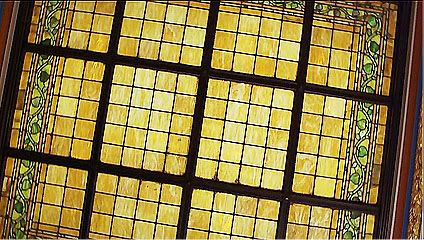
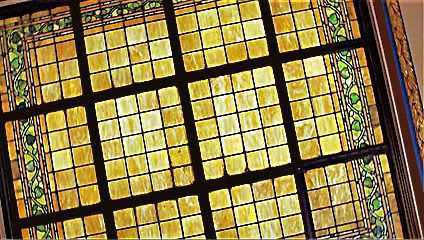
Stained Glass Windows in "Two Weeks Notice"


Above are screen shots of a building in New York, where Sandra Bullock's character from Two Weeks Notice goes to have an interview after quitting the demanding job of assistant-to-the-lawyer/secretary/wife-in role-only/nanny to Hugh Grant's character.

The building has a beautiful stained-glass ceiling, which the camera briefly twirls around as it follows Bullock and the lawyer who interviewed her come down the staircase. On the wall behind the banister are three imposing portraits of what look like Lowell, Hanes and Richards, names which are inscribed on tasteful steel in very large lettering below the portraits. These stern gentlemen quite likely run the firm, or are its founders, or are involved with some important contribution.

The whole film was shot in New York, at the urging of Bullock:
Shortly after the events of September 11th, Sandra Bullock, also the film's producer, urged that the film be shot entirely in New York to marshal support for the City and its production industry. No online "film location" website could give me any information on the building.
I've tried looking online for the building with these stained-glass ceilings, but I've had no luck so far. The film credits don't mention them, and other sources lead me to Grant's law firm building (Lucent Technologies building), and the Sky Studio in Greenwich Village which serves as the hotel in which Grant lives ("I own the hotel, and I live there. My life is very much like Monopoly." - I thought this was another funny line in the frequently funny movie, since surely jail must be one of the possibilities of his life of monopoly), but not to this particular building.

I bought the DVD (yes, that's how much I liked it, plus it was on sale), and have made screen shots of the stained-glass ceiling, which I've posted below.

The film is worth renting/buying. It has some good shots of New York, and Bullock and Grant are witty personalities, who are both very good actors. And as I've mentioned before, there are also some unexpectedly lovely scenes.

Aesthetics


Aristotle with a Bust of Homer
Rembrandt van Rijn, Dutch, 1606–1669
1653
Oil on canvas
56 1/2 x 53 3/4 in
Metropolitan Museum of Art


I have added Aesthetics to the list of topics. The philosophy of beauty is an important, and complex, topic, that I hope we will uncover in our quest to reclaim beauty.

Beautiful Libraries


Image from the blog Beautiful Libraries

A library is where we find inspiration for ideas. These ideas need not come directly from the books, but also from the objects in the library, and the construction of the library itself. The room's structure, its architectural design, the windows, doorways, stairways, are the preliminary focus for contemplation. The room's interior, its chairs, the wallpaper, the carpet, the ceiling's crown moudlings, provide a sense of order, structure, and aesthetic pleasure which augment those objects of art which it houses. The paintings on the wall, the statues and figures on the desk and other tables remind us of a particular era, a particular artist, and a particular subject, which may inspire us like to follow their examples, or to continue where they left off. Finally, there are the books. And these can be divided into three categories. First, the design of the books, with their ornate covers, or covers of interesting qualities, are like the aesthetic pleasures we would get out of objects of art. Then there is the title of the books, from heavy and serious titles to light and frivolous ones which expand our imagination to where these books wish to take us. Finally, there are the authors of these books, who inspire us to think like them, and who give us their tools and philosophies on how to understand the world better.

Finally, books are meant for reading, and not contemplating. There nothing more superficial than a library of books which have not been read and which sit on the shelves for prestigious show. Even the most precious of books, which at any moment could succumb to the heavy load of dust, are something that have to be opened and read.

Beautiful libraries are hard to find.

A reader sent me the link to a blog titled Beautiful Libraries. Can anyone contemplate beauty in a library like this, or like this? We should nourish our thoughts well.

How to Acquire Style and Substance


Cary Grant
Photo by Harry Benson
1957


A young man recently wrote to me and asked:
Your posts are great and so pertinent to the madhouse we currently live in. I was wondering if you think the slovenly dress habits will be discarded within the next 10 years or so as people get fed up with the general ugliness. Or are they too far gone?

I generally gird myself mentally before I enter the public square these days. I expect to see slobs, hear rude language, be tailgated, walk away from cell phone conversations etc. I'm praying that network news goes the way of dvds.

And the way people let their kids scream and screech!

I think Lawrence Auster called it the age of the "totally liberated self".

Is this anti-culture too far gone? Should we traditionalists run for the hills and try to carve out a little patch of sanity?

George Orwell (a weird kind of socialist) wrote an essay called "Some thoughts on the common toad" and concluded it saying that in spite of the lies spewing out into the world Spring is Spring and they can't stop you enjoying it. A little comfort I guess.
I answered him with what I thought would be a practical guideline on how to maneuver the non-aesthetic mentality of our age:
I don’t know. Beauty, beautiful things, like a culture and a country, take years, centuries, generations to build and solidify. Ugliness and destruction occur in very little time. Even consider dressing: It is easier to slap on anything as opposed to wearing clothes that have an aesthetic sense.

I think our era hasn’t constructed, or built, its aesthetic sense. Other eras built theirs, out of what came from their past. Ours hasn’t bothered with that. I think it stopped soon after the late sixties and early seventies. I cannot think of a definitive eighties, nineties or “new millennium” style, but I can immediately recognize sixties, fifties, forties, thirties, twenties, styles, and further into the past.

I’m still trying to figure out why that is, but I think it happened when beauty was “downsized” as I call it, and when people thought it was too elitist. It probably has to do with equality, as I write here. But the problem with “equality” is that it courts the lowest denominator, so everyone becomes equally ugly.

But, the interesting thing about aesthetics is that it doesn’t require “equality” to function in any and all levels of life. The young shop girl can look beautiful (or at least aesthetically pleasing) and can borrow her ideas form the wealthy socialite to form her own pleasant look. Also, when beauty is around, even in limited quantities, everyone benefits. A beautiful statue in park is for everyone to appreciate. A beautiful lady glimpsed at in her car (in a store, a restaurant, etc.) makes people happy, including the lowly shop girl. Beauty does make the world a better place, I’m convinced.

Anyway, back to your question:

I think it is possible to discard slovenly dress habits, and even sooner than within the next 10 years.

1. You can start right away. For example:

A. Rather than wearing sneakers, always wear good shoes.

B. Dress well when going out, even to the corner store.

C. Of course, over-dressing to the corner store can look odd, so try to fit your dress to the occasion. There are great casual clothes around, and you don’t have to slip on a silly t-shirt or a worn out sweat shirt to go out and buy your milk.

D. Have a good hair cut, perhaps copying a style from another period, or using a men’s magazine for ideas (some have surprisingly well-groomed men models).

E. Try to get things to match, in style, color, design etc.

F. Find good accessories like ties, hats, belts, handkerchiefs, jackets. The whole look matters.

G. Avoid jeans at all costs. They look sloppy, and they are boring and unattractive.

H. And behave well, gentlemanly and chivalrously.

2. Avoid these items:

- Sweat shirts or t-shirts
- Sneakers
- Jeans
- Shorts
- Thematic prints like a shirt you bought at your last rock concert, or the tie with Disney motifs.
- Dramatic prints. Stripes and small circles or diamonds on shirts is as far as you should go.
- Baseball hats
- Odd jewelry, or pierced ear/nose
- Tattoos
- Hoodies

3. Try to find different styles for different occasion

A. Office wear

This is still generally more formal. Even if you work in a casual office environment, dress as if you might meet your next new boss, or your big client.

B. “Street” wear

Street wear is less formal. But you are out showing yourself to the whole world. Do you want to be seen in sloppy t-shirt and jeans, or look nice, presentable and attractive? You can add the thematic printed shirt here, perhaps a Hawaiian shirt for summer, and penny loafers are a good substitute for sneakers. As a hat, a panama hat might be a nice touch rather than that ubiquitous, ugly baseball cap.

C. Week-end and home wear

You’d be surprised at how people dress at home, when they think that “no one” is looking. Of course, their own families are looking, observing and often mimicking. If you have young children, they will be influenced at how you present yourself even at home. Get out of the pajamas and dressing gown mode, and actually wear some real clothes that are not for sleeping in. “Pajama mode” dressing includes baggy sweat shirts and sweat pants, and t-shirts, sloppy slippers/flip flops, etc. Leave the t-shirts and sweat shirts for the garden or yard work. You can be comfortable in a loose shirt and pants. Try a Hawaiian shirt, a short-sleeved golf shirt, sweaters, penny loafers, Dockers once in a while.

D. Visitors/Visiting wear

Dress up when visiting friends, and when friends come to visit. Don’t overdue it, of course, if the event is casual, but look good. Rather than a sweat shirt, put on a dress shirt, or a short-sleeved golf shirt. Try different, subdued colors for a change, like pastel lilac or light blue. Don’t pull out the Hawaii shirt for this one. No jeans, of course, and no sweat pants. But tan Dockers are a good, neutral choice. Penny loafers, and more formal shoes like Oxfords, can substitute for sneakers.

E. Visitors and week-end and home wear are somewhat similar

In a way, you should be ready for some event, even if at home. Some-one may decide to pop in for a visit. Mix your “visitors wear” with your casual home wear when you’re at home.

4. Look for good examples and guides

A. Magazines

Look up GQ magazine and other men’s magazines. Many have surprisingly good selections of men’s clothes. But pay more attention to the ads. The articles are often featuring the next “avant-gard” designer, whereas the ads are more conservative.

B. Tailors

Go to a tailor. Try to find a small, modest, old-fashioned one, who has had some formal or “old world” training. Such tailors are often a wealth of information. Ask for their advice. Have a suit custom made.

C. Formal Occasions

Look around during formal occasions. See what people are wearing for weddings, engagement parties, christenings, office formal parties, etc. Formal wear has been downgraded so much that wedding suits might actually fit your every-day life style.

D. Public Figures

Watch what public figures – news anchors, presidential candidates, Donald Trump, etc. - are wearing. Study how they accessorize with their ties, handkerchiefs, shoes, hats, and even their hair styles. We are still a some-what conservative culture when it comes to how our leaders are dressed.

E. Fashion History

Look up the history of fashion. How did people dress ten years ago, fifteen years ago? In the fifties, or forties? In the 19th century? During Medieval times? You’d be surprised to find that men took what they wore very seriously. A knight is identified partly by what he wears. So is a king. As is an early twentieth century gentleman.

F. Fashion Statements and Items

Find distinguishing items of different eras, periods and styles. It could be the walking stick/umbrella of the English Gentleman. Or the colors of a sixteenth century costume which you can incorporate into the colors of your tie and lapel handkerchief. Or the hats worn in the 1950s.

G. Different Cultures

Look at different cultures around the world and study how they differentiate between formal wear and casual wear (e.g is “casual wear” universal?). Did they have specific, attractive wear for men? Were men and women equally well-dressed?

H. Different Classes

How do the rich and the poor dress? You might think that only the wealthy are concerned with looking good. But, all walks of people dress cleanly, respectably, and with some flair. Poor people in Africa, for example, the poorest of the poor in the world, managed to develop a bright and cheerful style, with imaginative tie-dye, block print and batik fabrics, which million-dollar designers copy as their latest runway creations. Even cheap Walmart clothes are often colorful and attractive.

I. T.V. Shows and Movies

If you watch T.V., try to find shows that can give you good style examples. Subscribe to a “Hollywood movies” channel and watch shows and movies from the forties and fifties. We can still relate to those styles, and in fact they’re making a come-back. Study the suit cuts, the colors men wore, the shoes and ties, the hair cuts. Find what you like, and what can fit into your lifestyle, and just copy it!

Cary Grant shows true style and substance with a simple, relaxed pose (see above image). No aggressive expression, no slovenly style. Here is male aesthetics at its best.

J. Vintage Styles

Look for vintage style magazines (including women’s magazines), style history books, etc., and read about the dress and style expectations of those eras. Go to antique and vintage clothing stores and search their racks. As the shop owners for information. Many of them have a fountain of knowledge about style and design.

5. Ignore those who call you "old fashioned"

The MTV DJs or the slovenly week-end sweat shirt wearers have become standard bearers of our contemporary style. They are NOT experts. If your children or younger acquaintances tease you about your style, ignore them, and continue with what you’re doing. They will come around if they see you’re serious. Young people are susceptible to beauty, both boys and girls. We just need to show and teach them. Adults who tease you with subtle jibes are not worth paying attention to, especially if they are the types that wear the droopy sweat shirts and old t-shirts. They might come around, but don’t be too concerned about that.

6. How to approach those annoying loud cell-phone monologues, and jeans hanging down to the knees

Find it in yourself to “confront” slobs, bad language, loud cell phone conversations disclosing intimate details, etc. Don't do this every day, though, and don't stress yourself out. But, try it once in a while to show such people that they’ve passed beyond norms of decorum. This might get risky since people can get really angry, but assess who you can do it to. People need to know that such behavior is unacceptable.

7. How to personally make a difference

I think revolutionary things start with leaders, or those who take a bold step ahead of others, and who are not afraid of confrontations and negativity. But, prepare yourself mentally, intellectually and personally before you embark on your “making a difference” mission. Here are some things you can start with:

A. Start a blog.

B. Write letters to the editor.

C. Find a magazine, a newsletter, a community paper etc. which will accept your articles.

D. Talk to family and friends about your observations, especially if it concerns them.

E. Make suggestions to your retail stores about clothing items to bring into the store.

F. Form a society like "The Society of Sartorially Conscious People," or "The Well Dressed Group" as you develop ideas and plans on how to make the differences you wish to see around you. Many changes in the past occurred because people formed groups of some kind for support and for strength. Fashion is no less serious, and requires as much energy as any other movement.

8. Change your manners and style to fit your message

A. Please, thank you and excuse me go a long way.

B. Decent and polite behavior attracts people to you and your style.

C. Don’t shirk from full-on arguments, and don’t get bullied by bullies. But choose your place and your manner carefully when interacting with such people. Often, abrasive behavior will only alienate you from others, and prevent you from making your influence. Everyone can a potentially be on your boat, but some more than others.

9. Running to the Hills

I haven’t thought about this. I think it is an option, or could be an option. But this place, this whole place and not some cave in the hills, is our world. I think we need to defend it where we are. We can metaphorically run to the hills by building our own community as I have described above. But that should (could?) be the start of us building our defensive/offensive strategies, when we can begin more concrete changes. I think some inevitable confrontation is looming in the future, so we better get ready now.

10. "Spring is Spring and they can't stop you enjoying it."

And yes, you are right (or George Orwell is right). There are still many beautiful things around us, natural, cultural, familial, and so on. Enjoy the lovely spring that is already here, and the warm summer months just ahead of us. Read good books, look at good art, take care of yourself physically and spiritually. Start a hobby such as photography, woodwork, marathon running, etc., to enjoy life and to keep you in good spirits. We are not here to destroy, but to create.
And be good to people, even the slothful ones.

The God of Wine


Cabernet Sauvignon Vista Point, which my local
restaurant sells for $6.5 (half price on Tuesdays).

Here is how it is described:
Vista Point Cabernet Sauvignon from California.
Intense blackberry and currant, a smooth easy
drinking wine for any occasion.

I go to my local restaurant (Moxie's in Mississauga) to read C. S. Lewis' Mere Christianity or Roger Scruton's Beauty. They also have WiFi, so I can take my laptop and work on my projects, either this Reclaiming Beauty weblog, or my own chapters of my book Mere Culture. The 5oz glass of red wine is enough where: "Under [Dionysus, the Wine god's] influence courage was quickened and fear banished, at any rate for the moment...[W]hile it lasted it was like being possessed by a power greater than themselves" as Edith Hamilton writes in Mythology, (the fuller quotation is below).

Below are photos I took recently of Dionysus at the Toronto Royal Ontario Museum:


Dionysos: God of wine
Marble head and torso
Roman copy after Praxitelean work of the 4th Century B.C.
His appearance matches descriptions in classical literature:
"A magical enchanter..., his bond hair smelling of perfume
his cheeks flushed with charms of Aphrodite in his eyes"
Euripedes, Bacchae 192-194

[The above description is from the information plaque beneath the sculpture]
[Photo by Kidist P. Asrat]


Protome of Bearded Dionysus
The wine god is shown here holding an egg and a drinking cup (kantharos).
The handsome face shows stylistic influences of the great Attic sculptor Phidias

[The above description is from the information plaque beneath the object]
[Photo by Kidist P. Asrat]

Phidias, according to Wikipedia was:
Phidias, or The Great Pheidias (c. 480 – 430 BC), was a Greek sculptor, painter and architect, who lived in the 5th century BC, and is commonly regarded as one of the greatest of all sculptors of Classical Greece. Phidias' Statue of Zeus at Olympia was one of the Seven Wonders of the Ancient World. Phidias designed the statues of the goddess Athena on the Athenian Acropolis, namely the Athena Parthenos inside the Parthenon and the Athena Promachos, a colossal bronze statue of Athena which stood between it and the Propylaea, a monumental gateway that served as the entrance to the Acropolis in Athens. Phidias was the son of Charmides of Athens.
The ROM has no online photo or description of this bearded Dionysus, and the museum's research and Greek department experts were unable to help ("it's Friday," "it's Friday afternoon," told me the telephone responder - as though people don't work on Friday's, especially in museums. Finally he just told me to come over. Until then, I will provide the information above which I hopefully reached correctly through deduction).

According to the great female historian Edith Hamilton, whose book Mythology I've used as a reference for many antiquity-related material, Dionysus was the Greek version of the Roman god Bacchus (actually, that should be the other way around, if we are to follow chronology).

The Greek Dionysus was a much more interesting and imaginatively created god than Bacchus. Hamilton is enchanted by the Greeks, whose fertile imagination she admires much more than the staid Roman personality. The Greek gods were equally imaginative, but often harsh and cruel, both to each other and to their human proteges.

Hamilton writes about Dionysus:
The ideas about Dionysus in these various stories seem at first sight contradictory. In one he is the joy-god -
He whose locks are bound with god,
Ruddy Bacchus,
Comrade of the Maenads, whose
Blithe torch blazes
In another he is the heartless god, savage, brutal -
He who with a mocking laugh
Hunts his prey,
Snares and drags him to his death
With his Bacchanals.
The truth is, however, that both ideas arose quite simply and reasonably from the fact of his being the god of wine. Wine sib ad as well as good. It cheers and warms men's hearts; it also makes them drunk.The Greeks were a people who saw facts very clearly. They could not shut their eyes to the ugly and degrading side of wine-drinking and see only the delightful side. Dionysus was the God of the Vine; therefore he was a power which sometimes made men commit frightful and atrocious crimes. No one could defend them, no one would ever try to defend the fate Pentheus suffered. But, the Greeks said to each other such things really do happen when people are frenzied with drink. This truth did not blind them to the other truth, that wine aws "the merry-maker," lightening men's hearts, bringing careless ease and fun and gaiety.
The wine of Dionysus,
When the weary cares of men
Leave every heart.
We travel to a land that never was.
The poor grow rich, the rich grow great of heart.
All conquering are the shafts made from the Vines.
The reason that Dionysus was so different at one time from another was because of this double nature of wine and so fo the god of wine. Hewwas man's benefactor and he was man's destroyer.

On his beneficent side he was not only the god that makes men merry. His cup was
Life-giving, healing every ill.
Under his influence courage was quickened and fear banished, at any rate for the moment. He uplifted his worshipers; he made them feel that they could what they had thought they could not. All this happy freedom and confidence passed away, of course, as they either grew sober or got drunk, but while it lasted it was like being possessed by a power greater than themselves. So people felt about Dionysus as about no other god. Hew was not only outside of them, he was within them, too. They could be transformed by him into being like him. The momentary sense of exultant power wine-drinking can give was only a sign to shwo men that they had within them more then they knew;"they wold themselves become divine."
Hamilton then continues a fascinating thesis that Dionysus was the precursor to Christ (which many other scholars have also discussed:
To think in this way was far removed from the old idea of worshiping the god by drinking enough to be gay or to be freed from care or to get drunk. There were followers of Dionysus who never drank wine at all. It is not known when the great change took place, lifting the god who freed them through inspiration, but one very remarkable result of it made Dionysus for all future ages the most important of the gods of Greece.
[...]
The greatest poetry in Greece, and among the greatest in the world, was written for Dionysus. The poets who wrote the plays, the actors and singers who took part in them, were all regarded as servants of the god. The performances were sacred; the spectators, too, along with the writers and the performers,were engaged in an act of worship. Dionysus himself was supposed to be present; his priest had the seat of honor.
[...]
The strange god, the gay reveler, the cruel hunter, the lofty inspirer, was also the sufferer. He, like Demeter, was afflicted, not because of grief for another, as she was, but because of his own pain. He was the vine, which is always pruned as nothing else that bears fruit; every branch cut away, only the bare stock left; through the winter a dead thing to look at an old gnarled sump seeming incapable of ever putting forth leaves again.. Like Persephone Dionysus died with the coming of the cold. Unlike her, his death was terrible: he was torn to pieces, in some stories by the Titans, in others by Hera;s orders. He was always brought back to life; he died and rose again. It was his joyful resurrection they celebrated in his theater, but the idea of terrible deeds done to him and done by men under his influence was too closely associated with him ever to be forgotten. He was more than the suffering god. He was the tragic god. There was none other.

He had still another side. He was the assurance that death does not end all. His worshipers believed that his death and resurrection showed that the soul lives on forever after the body dies. This faith was part of the mysteries of Eleusis. At first it centered in Persephone who also rose from the dead every spring. But as queen of the black underworld she kept even in the bright world above a suggestion of something strange and awful: how could she who carried always about her the reminder of death stand for the resurrection, the conquest of death? Dionysus, on the contrary, was never thought of as a power in the kingdom of the dead. There are many stories about Persephone in the lower world; only one about Dionysus - he rescued his mother from it. In his resurrection he was the embodiment of the life that is stronger than death. He and not Persephone became the center of the belief in immortality.

Around the year 80 A.D., a great Greek writer, Plutarch, received news, when he aw far from home, that a little daughter of his had died - a child of most gentle nature, he says. In his letter to his wife he writes: "About that which you have heard, dear heart, that the soul once departed from the body vanishes and feels nothing, I know that you give no belief to such assertions because of those sacred and faithful promises given in the mysteries of Bacchus which we who are of that religious brotherhood know. We hold it firmly for an undoubted truth that our soul is incorruptible and immortal. We are to think (of the dead) that they pass into a better place and a happier condition. Let us behave ourselves accordingly, outwardly ordering our lives, while within all should be purer, wiser, incorruptible."
Of course, there is also the Eucharist:
Matthew 26, verse. 27-28
And he took the cup, and gave thanks , and gave it to them, saying , Drink ye all of it;
For this is my blood of the new testament, which is shed for many for the remission of sins.

The bottle has a small poppy flower as its motif.


According to this list of epithets, Dionysus is also called "Dionysos of the Poppies."

Of course, the poppy produces a drug which, like alcohol "Under [whose] influence courage was quickened and fear banished, at any rate for the moment...[W]hile it lasted it was like being possessed by a power greater than themselves."

I will conclude with a happy note that some amongst modern folks may have still some understanding of our history and our inheritance, and are able to bring it subtly into the forefront.

A $7/glass of a 2009 Cabernet Sauvignon [pdf file] carefully crafted so that its taste and its appearance has some poetic and cultural significance is something to wonder at.

Nectar For the Gods


Nectar For The Gods
Logo for Harp Lager


Harp Lager is available at my local Irish Pub, Failte's, whose interior I've photographed and the photos I've posted here. The menu describes it as an "imported beer" which I assume means from Ireland. The wait staff knows me now, and I sit in the back with my laptop or other mobile device (not my scooter, as Jerry Seinfeld quipped in one of his jokes), write my Reclaiming Beauty drafts, and add to my Mere Culture book that is still in the works.

I usually go during the Shona Hour, which translated means Happy Hour, and get my 1/2 pint of Harp Lager.

This site describes the beer as:
Dry and malty with a crisp hop finish
I agree. The taste is surprisingly strong, but the "crisp hop" gives it an unexpected sweetness and lightness.

The brewery is in Ireland, although it is called Guinness USA "and was born in 1960 as an answer to the rising thirst for lagers in Ireland and the UK."

Here is more detailed information on the beer, under "tasting notes":
Appearance: Golden and brilliantly clear.
Aroma: A subtle grainy sweetness with hints of lemon citrus.
Flavor: A dry, malty front slowly gives way to a crisp and dry
hoppy finish with notes of green apple and pear. Crisp and dry,
finishes remarkably smooth.
Food Pairing: Harp Lager's pale malt flavor compliments fruits,
while its dry, crisp hops accentuate spicy flavor. Serve with fried foods;
creamy soups and sauces; light fish and shellfish; mild cheeses;
Italian, Mexican, Indian, Cajun, Southwestern, and Asian dishes.
Nectar for all palettes. To accompany the Harp, I recommend the sweet potato fries, a 1/2 price appetizer during Shona Hour.


Harp Lager engraved in glass
Failte Irish Pub, Toronto

[Photo by Kidist P. Asrat Photographs]

Violette Doesn't Compare to Violet Eyes


Sephora's is a good place to test the latest in perfumeries. They have a system where they give you a small sample of a scent in a plastic container. Perfumes (eau de toilettes, eau de parfums, etc.) these days cost in the $50s and $60s, so it isn't pleasant to have an unpleasant perfume hanging around in one's cabinet (although I do use some as room freshers, since they are better than those store-bought sprays).

I go to Sephora's and simply walk through the aisles to see if they have anything new. Well, the Italian brand Tocca has a new perfume out called Tocca Violette.

I told the salesgirl that I do have Tocca Bianca (but didn't elaborate that I ended up using it as a room spray), so she doesn't think I'm doing the rounds for free samples. Tocca Bianca had an interesting lavender note, but it ended up smelling too much like dried lavender flowers.

The minute I smelled Tocca Violette, it reminded me of Elizabeth Taylor's Violet Eyes (which I reviewed here). I wasn't sure what it was, but it seemed like a slightly diluted version. The store's perfume data base wasn't working, and the salesgirls never have a clue what they're selling, so I waited until I got home to find out the notes.

Along the way, I sprayed Tocca Violette on one sleeve and Violet Eyes on the other, to see the lasting power (and dried down scent) of both. Tocca Violette was almost gone in about half an hour leaving a trace of unidentifiable "rough" scent behind, whereas Violet Eyes stayed on in its original form, and is still delicately perceptible on my sleeve. Why buy an expensive, $60, perfume, if it's main notes disappear in less than and hour, and leave behind unpleasantness?

Here is a long (but funny) review from Fragrantica's site by "Sherapop" who also has her own perfume blog at Sherapop's Salon de Parfum:
I love violets. I love thick-glass bottomed bottles, and Tocca's is one of the best...

...The problem with VIOLETTE, for me, is that there is an aquatic facet which shrouds and even compromises the presentation of the violets. I'm not saying that violets have to be soloists...but here I feel that the violets are overwhelmed by some sort of aqualia...

Needless to say, I won't be purchasing any more of this fragrance, but I'm pretty sure that I'll never be able to throw this bottle away. It's really too bad that we've no further need for paperweights... I'll add this one to my collection of "implement of self-defense to leave within arm's reach on the bedside table in the event of an uninvited nocturnal visitor" bottles
I wasn't wrong.

By the way, Sherapop has purple roses as the background to her blog. I have the purple rose as the main symbol for my blog.

Here are the notes in Elizabeth Taylor's Violet Eyes:
Top: White Peach
Middle: Purple Rose, Jasmine
Base: Violet, Cedar Wood, Amber

Here are the notes in Tocca Violette:
Top: Ginger, Bergamot, Coriander
Middle: Bulgarian Rose, Violet, Black Current
Base: Cedar, Musk

Tocca has the same fruity (black current instead of white peach) scent, but the black current is stronger and fruitier. There is rose in the middle notes, but Tocca's is less pronounced. Violet Eyes leaves out the musk, which can be an overpowering base, and instead adds the lighter cedar wood and amber. And finally, while Violet Eyes has the delicate violet in the base, giving it a more dominant presence, Tocca puts it in the middle notes, and it is overwhelmed by the other stronger notes, including the musk.

Overall, Tocca's Violette, which I am convinced is a copy of Elizabeth Taylor's Violet Eyes, is a more astringent - too fruity - version of Violet Eyes, and lacks the subtle wafts of rose and of course violet. It also leaves behind an unpleasant "unperfumy" scent as its dry-down.

Finally, I don't like Tocca's bottom-heamvy bottle (all their bottles are like that), although the glass is thick and nicely chiseled. Violet Eyes is a more elegant, long flask, with a thick band crystals surrounding the lid.


Fund Raising

I am raising funds to initiate my project "Reclaiming Beauty."

Please use the most convenient method to submit the funds:
- Contact me by email, and I can send you my mailing address
- Contact me by email, and I can send you information for direct deposit into my bank
- Use a secured Paypal deposit method by linking to the Donate button on the side

Thank you in advance for your interest.

I will send a gift, from my own "Trillium Series" designs, for the corresponding contributions:

$20 - Brooch/Button


$35 - Note Cards (Pack of ten)


$55 - Mug


$75 - Tote-Bag


$100 - Wall Clock


Elizabeth Arden is Behind Elizabeth Taylor's Violet Eyes


Elizabeth Taylor says about her perfume Violet Eyes, which came out in 2011:
"I love fragrances, and wanted Violet Eyes to make women feel beautiful, sophisticated and sensual. It was a great joy to create Violet Eyes with a bouquet of fragrance notes that I adore, carefully fine tuning every aspect of it.

Everything, down to the last detail, comes from my heart and soul. I send this fragrance into the world with love..."
Perfumer Carlos Benaim, the designer of Violet Eyes, describes his creative process:
At first, you perceive the brightness of her gaze. Then she looks straight at you, and there you are, staring into the most famous eyes in the world. And they are indeed violet, absolutely unique and truly beautiful.

Both the bottle and the outer package were carefully designed to my specifications. The contrast of both shiny and matte surface and watercolour violets combine to make this an exquisite design.
Here are the notes for Violet Eyes:
Top: White Peach
Middle: Purple Rose, Jasmine
Base: Violet, Cedar Wood, Amber
The perfume is available through Elizabeth Arden.

Sears Leather Gloves


At $20, these gloves are elegant, and they are lined with felt, keeping hands and fingertips warm.

Nordstrom Grey Cloche Hat


This can be worn for mild winter days.

Online Nordstrom store here.

Guess Quilted Leather Bag


Guess has the alternative to the Chanel quilted handbags, and no-one would know the difference.

Essie Pink Lemonade


For a subtle nail color, Essie's Pink Lemonade nail polish gives color without the gaudiness. It is better with a double coating.

Sears Kitten Heels


Low heels for maximum comfort at Sears.

Sears Pink Ruffle Scarf


A double wrap keeps in the warmth.

Bowring Rose Toile Tea Mugs


The lid really does keep the tea (or coffee :-)) piping hot.

This Bowering line comes as an individual mug or as a set of two. Tea cups and cake plates and stands are also part of the line.